A quiz of character · 28 statements
7 Heavenly Virtues Test
Which virtue leads your life? Answer 28 honest statements and see how chastity, temperance, charity, diligence, patience, kindness and humility rank in you.
The short answer
The 7 Heavenly Virtues Test is a free, 28-statement quiz that measures how strongly each of the seven heavenly virtues shows up in your everyday choices. In about three minutes it returns a ranked profile of all seven and names the virtue that leads.
The test
Answer for the person you are on an ordinary Tuesday, not the person you are on your best day.
Before you begin
Seven virtues.
One honest look.
There are no right answers and nothing here is scored against you. Choose the response that is true most of the time. Your answers never leave this browser.
- 28 statements
- 5-point scale
- About 3 minutes
A reflection tool, not a psychological assessment. No account, no ads. Your answers stay in this browser.
Statement 1
I can stop at “enough” — one more drink, one more episode, one more purchase — without much of a fight.
Tap an answer to continue · or press 1–5
Your guiding virtue
Caritas
Charity
The Open Hand
Your seven virtues
Ranked by affinity, 0–100
Your answers are processed in this browser and never uploaded. Page views are measured with Google Tag Manager/GA4; no account to create.
The seven
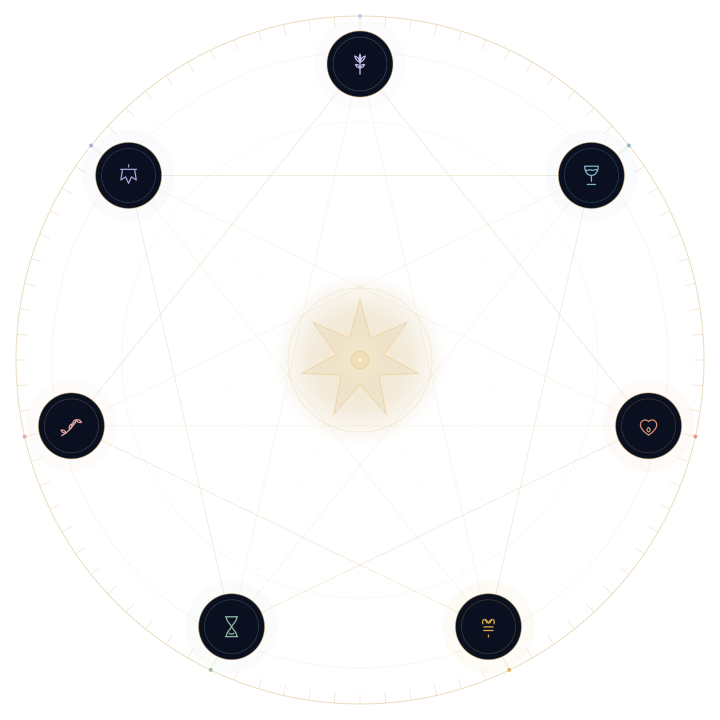
Seven virtues, seven vices they answer
Each virtue in the classic list is paired with a deadly sin it is said to heal. The pairing is old, practical and surprisingly useful: it turns an abstract ideal into a habit you can practise.
-
Chastity Castitas
Purity of heart and fidelity — keeping intimacy within the boundaries you choose, and never using a person to get a feeling.
Opposes Lust
-
Temperance Temperantia
Self-governance around appetite. Knowing what enough feels like with food, drink, screens, spending and work — and stopping there.
Opposes Gluttony
-
Charity Caritas
Love that acts. Generosity with money, time, attention and credit — especially toward people who cannot repay you.
Opposes Greed
-
Diligence Diligentia
Steady effort. Finishing what you start, doing the boring part well, and keeping promises when no one is watching.
Opposes Sloth
-
Patience Patientia
Equanimity under delay. Absorbing frustration without passing it on, and letting anger inform you instead of command you.
Opposes Wrath
-
Kindness Humanitas
Warmth in action. Noticing the overlooked, softening a hard truth, and doing small good without an audience.
Opposes Envy
-
Humility Humilitas
Accurate self-knowledge. Being wrong without collapsing, asking for help, and preferring to be useful over impressive.
Opposes Pride
-
Which one leads you?
Twenty-eight statements. Seven ranked virtues. About three minutes.
Take the test
Method
How the test works
No timer, no trick questions, no personality “type” pulled out of a hat. Just a consistent score for each of the seven virtues.
-
01
You answer 28 statements
Four statements per virtue, each answered on a five-point scale from “Not like me” to “Exactly like me”. Choosing an answer moves you straight on; the back arrow lets you change one.
-
02
Every virtue is scored
An answer adds 0–4 points to the virtue it belongs to, plus a small secondary weight to a closely related virtue. Each virtue is then scaled to the same 0–100 range, so none has an advantage. If two virtues tie, the stronger secondary score decides; if they are still level, the classic list order does.
-
03
You get a ranked profile
Your strongest virtue, the second virtue that colours how you practise it, the vice it answers, and the virtue with the most room to grow — plus a profile you can share.
“I can stop at enough — one more drink, one more episode, one more purchase — without much of a fight.”
Context
Where the seven virtues come from
A teaching list, not a single ancient document.
The seven heavenly virtues grew out of older Christian moral teaching. The four cardinal virtues — prudence, justice, fortitude and temperance — were described by classical philosophers and taken up by Thomas Aquinas; the three theological virtues of faith, hope and charity completed the framework. The Catechism of the Catholic Church still defines a virtue the same way Aquinas did: “an habitual and firm disposition to do the good” (§1803).
The seven-item list most people know today is usually traced to the medieval habit of opposing each deadly sin with a healing virtue. Prudentius’ poem Psychomachia, written around 400 CE, stages literal battles between virtues and vices and made the pairing vivid for centuries of readers. Later catechetical lists standardised the seven pairs used on this page: chastity against lust, temperance against gluttony, charity against greed, diligence against sloth, patience against wrath, kindness against envy, and humility against pride.
Why test any of this? Because virtue ethics is interested in what you do repeatedly, not what you believe in theory. A quiz cannot measure your soul. It can, however, hold up a mirror to your habits — and that is the only claim this one makes.
- Prudentius — the early-5th-century poet whose Psychomachia dramatised the virtue–vice conflict.
- Thomas Aquinas, Summa Theologiae II-II — the classic treatment of the virtues.
- Catechism of the Catholic Church §1803–1829 — definitions of the cardinal and theological virtues.
Disambiguation
Which seven virtues? Two lists share one name
If you have seen a different list — prudence, justice, fortitude, faith, hope — that is the older cardinal-and-theological framework, not the seven pairs used here. Both are legitimate; they answer different questions.
| Comparison | Seven heavenly virtues (this test) | Cardinal + theological virtues |
|---|---|---|
| What it lists | Chastity, temperance, charity, diligence, patience, kindness, humility | Prudence, justice, fortitude, temperance — plus faith, hope, charity |
| Where it comes from | Medieval devotional tradition pairing each deadly sin with a remedy | Classical philosophy and Christian theology; Catechism §1805 and §1813 |
| What it is for | A mirror for everyday habits, scored in this test | A framework of moral and theological formation |
| Shared names | Temperance, charity | Temperance, charity |
The seven-item list is a devotional and catechetical tradition rather than a formal enumeration in the Catechism; in popular usage these are also called the capital virtues, because each remedies one capital sin. This test scores them because each maps onto one deadly sin and describes behaviour you can actually observe in yourself.
Questions
7 Heavenly Virtues Test FAQ
Short, direct answers about the test, the scoring and the tradition behind the seven virtues.
What is the 7 Heavenly Virtues Test?
It is a free, 28-question personality quiz that ranks seven virtues in you — chastity, temperance, charity, diligence, patience, kindness and humility — and names the one that most shapes your choices. It is built for self-reflection, not diagnosis.
Which heavenly virtue is strongest in me?
The test scores every virtue separately, so the strongest one is whichever earns your highest total across its four statements. Your second-highest score often shows the style in which you practise the first — for example, charity expressed through patience.
How many questions does the 7 Heavenly Virtues Test have?
Twenty-eight statements, four for each of the seven virtues, answered on a five-point scale from “Not like me” to “Exactly like me”. Most people finish in about three minutes.
Is the 7 Heavenly Virtues Test free?
Yes. The test is free and there is no sign-up, email wall, timer or advertising.
Is this test scientifically validated?
No. It is inspired by virtue ethics and by the design of modern self-report quizzes, but it is not a validated psychometric instrument. Treat the result as a prompt for reflection, not a diagnosis or a basis for hiring, dating or clinical decisions.
Are my answers stored?
No. Your quiz answers stay in your browser and are never sent to us. A result you choose to share is encoded in the link itself. We do use Google Tag Manager and Google Analytics 4 to measure page views — see the next question.
Does the site use cookies or analytics?
Yes. Google Tag Manager (container GTM-WC369VTH) loads Google Analytics 4 to measure aggregate page views. Google may set analytics cookies (such as _ga and _ga_*) and receives standard technical data such as page URL, referrer, device type and approximate location. Quiz answers are never sent. Blocking analytics with a content blocker does not affect the test.
What are the seven heavenly virtues?
Chastity (castitas), temperance (temperantia), charity (caritas), diligence (diligentia), patience (patientia), kindness (humanitas) and humility (humilitas).
What is the opposite of each heavenly virtue?
The classic pairings are chastity against lust, temperance against gluttony, charity against greed, diligence against sloth, patience against wrath, kindness against envy, and humility against pride.
Are the seven heavenly virtues in the Bible?
Virtues such as love, patience and humility are central to biblical ethics, for example in Galatians 5:22–23 and 2 Peter 1:5–7. The specific seven-item list paired against the seven deadly sins is a later Christian teaching tradition rather than a single biblical list.
Are the seven heavenly virtues the same as the seven gifts of the Holy Spirit?
No. The seven gifts — wisdom, understanding, counsel, fortitude, knowledge, piety and fear of the Lord — are a different list. The seven heavenly virtues are habits to practise, not gifts received.
How is my result calculated?
Each statement adds 0–4 points to the virtue it belongs to, and a small secondary weight lets closely related virtues benefit from the same answer. Every virtue is scaled to the same range before the seven are ranked.
How do I share my result?
Use the share buttons beneath your result, copy the result link, or download a share card. The link reopens the same result on any device without storing anything on a server.
Where does the list of seven heavenly virtues come from?
The seven-item list grew out of a medieval devotional habit of opposing each deadly sin with a healing virtue. Prudentius’ Psychomachia, written around 400 CE, dramatised battles between virtues and vices; later teaching lists standardised the seven pairs used here. The older cardinal and theological virtues are a separate framework.
Do I need to be religious to take the test?
No. The test measures habits and behaviour, not belief or church attendance. The virtues come from a Christian tradition, but the statements are written so that anyone can answer them honestly.
Can my strongest virtue change over time?
Yes. Virtues are habits, and habits move with what you practise. Taking the test again after a few months often shows a different profile, especially around the virtue you have been working on.
Why do some quizzes list prudence, justice and fortitude?
Those quizzes use a different, older enumeration: the four cardinal virtues plus the three theological virtues. This test uses the seven virtues traditionally paired against the seven deadly sins, so the two sets of scores are not directly comparable.
Can I take the 7 Heavenly Virtues Test on my phone?
Yes. The quiz is designed mobile-first: tap an answer and the next statement appears automatically, with a back control if you want to change one.
About
A mirror, not a verdict
The Seven Virtues Project builds small, quiet tools for self-reflection. This test is free, has no advertising, and asks for nothing but your attention. It is not affiliated with any church or religious organisation, and it does not judge your faith — or lack of one. The virtues are offered here as a vocabulary for character, useful whether you read them theologically or simply as a set of good habits.
Privacy. Quiz answers are processed in your browser and never sent to us. A completed result is stored in your browser only so you can return to it; a shared link carries the scores in its own URL. We use Google Tag Manager (container GTM-WC369VTH) with Google Analytics 4 to measure aggregate page views. Google may set analytics cookies and receives standard technical data such as page URL, referrer, device type and approximate location; quiz answers are not part of that data. There is no server-side quiz profile of you, and no advertising.
Page last updated 22 November 2026.